
What Manufacturers Must Know Before Starting an AI Project
Starting an AI project in a factory sounds straightforward: identify a bottleneck, gather data, deploy a model, measure results. Yet industrial AI often fails before it begins. The reasons are rarely technical; they are operational.
Manufacturers underestimate the complexity of preparing plants, teams, and workflows for intelligent systems. Before choosing an algorithm, examine whether the factory is truly ready. Skipping this step can be subtle, expensive, and long-lasting.
1. Data Discipline Is the First Bottleneck
Factories generate massive data, but quantity is not readiness. PLCs, SCADA, and MES platforms capture logs over years, yet the structure, quality, and consistency rarely support AI.
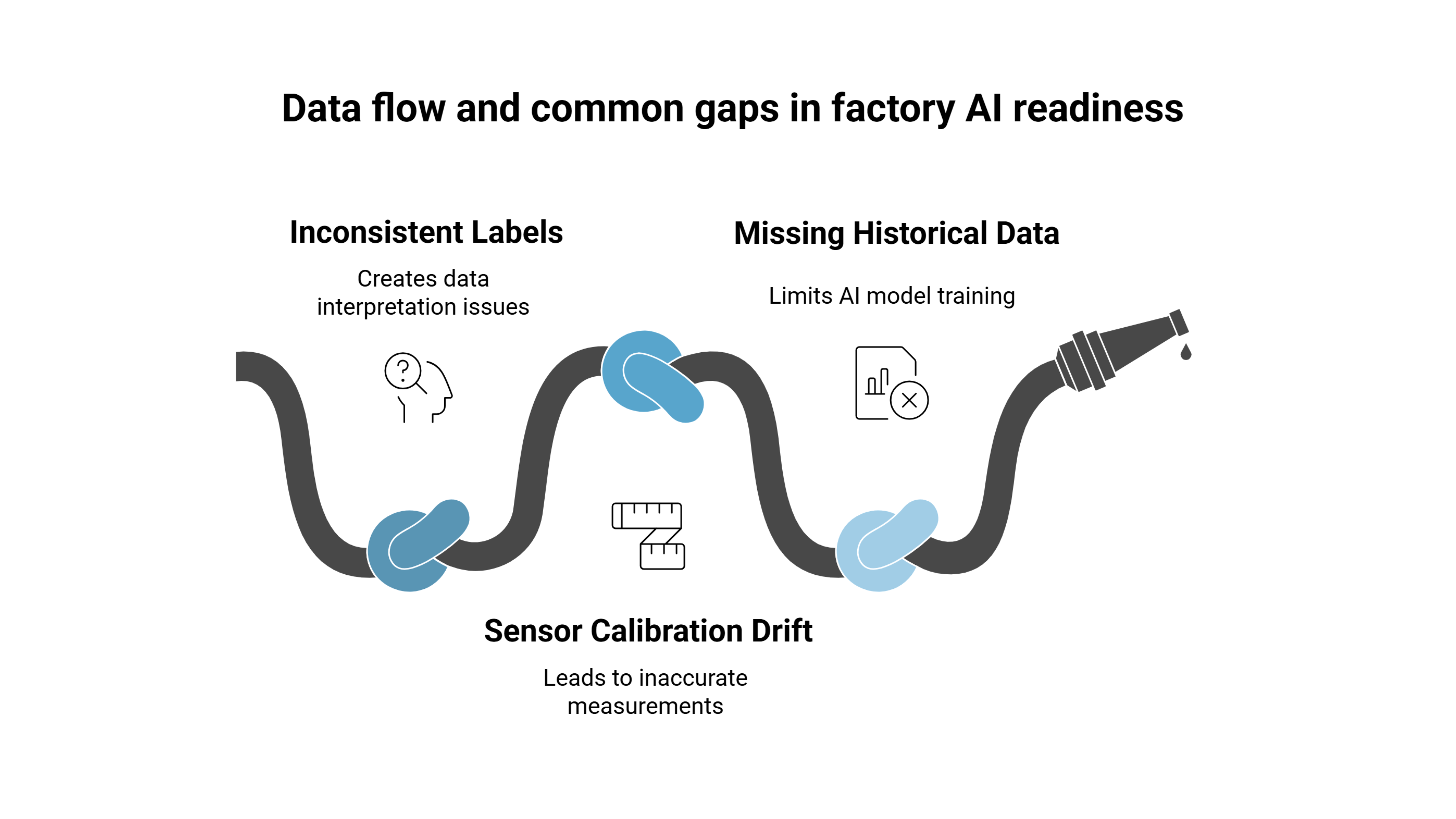
Consider a production line where shift A logs downtime as "Mechanical," shift B calls it "Maintenance," and shift C chooses "Other." Sensor calibration drifts slowly, and a new SKU alters cycle times, but historical labels remain unadjusted.
Supervisors adapt instinctively; models do not. AI interprets inconsistencies as patterns, producing conflicting insights. The result is wasted cycles, eroded trust, and stalled adoption.
Manufacturing AI readiness starts with treating data as structured, version-controlled assets. Misaligned logging, inconsistent alerts, and unclear decision flows are common reasons pilots stall, which is why understanding the operational reasons behind AI failures is crucial.
2. Integration Is About Embedding Decisions
Integration is more than connecting systems. Pulling data from PLCs into dashboards does nothing if outputs exist outside operational decision flows.
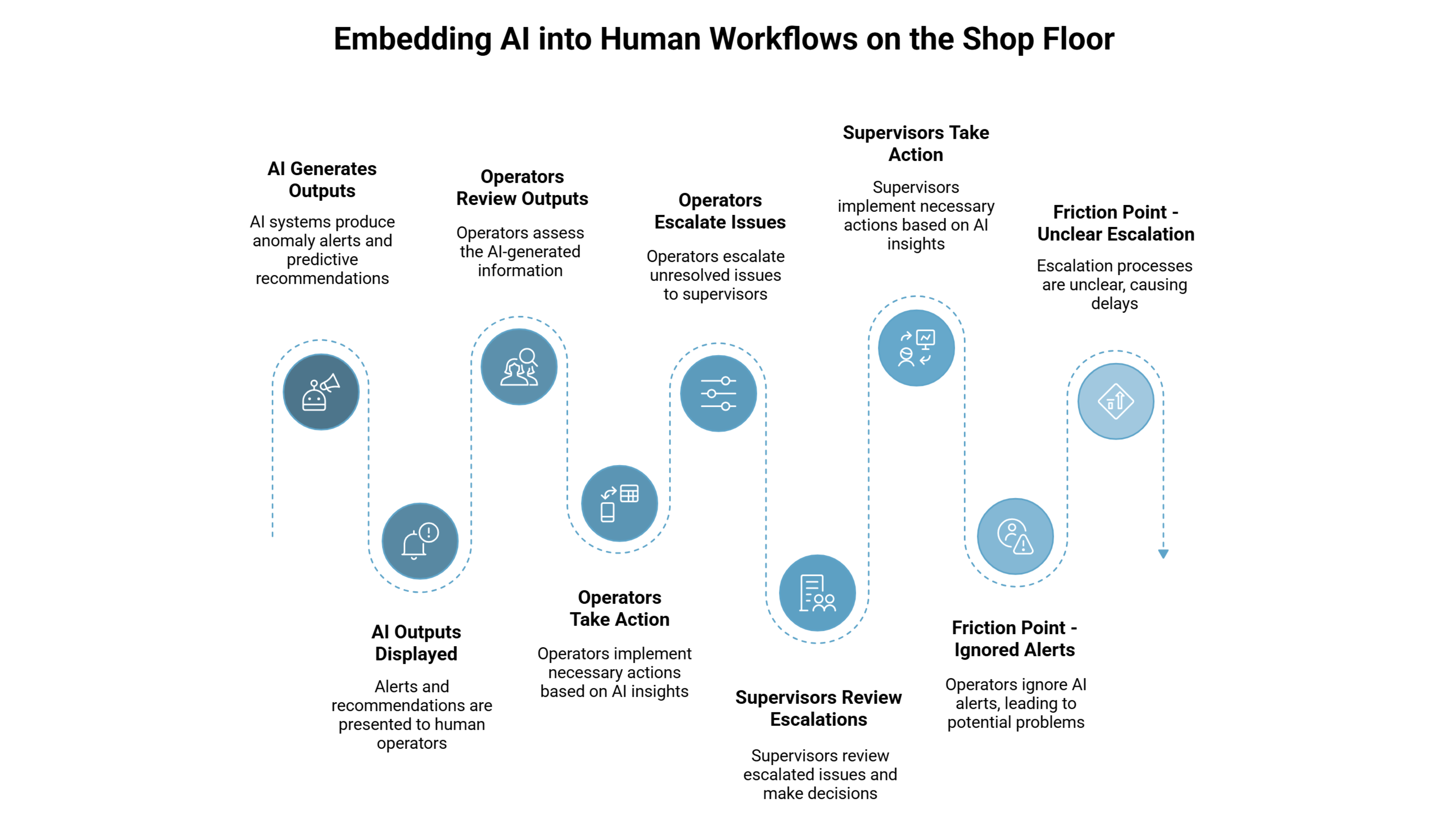
An anomaly alert at 2:17 PM is meaningless if no one has authority or time to act. Can the operator adjust the line? Does maintenance reprioritize tickets? Are supervisors accountable for false alarms?
Alerts either get ignored or cause confusion if authority pathways are unclear. Successful AI embeds outputs into workflows. Operators must know what to do, supervisors must support action, and processes must accommodate AI input without disrupting production.
This is part of the Operational Stability Threshold, the minimum alignment of authority, accountability, and process clarity required for AI to produce measurable impact.
3. KPI Alignment Is Tricky
Manufacturers often aim to improve OEE, reduce downtime, or increase throughput. But optimization always involves trade-offs.
Higher throughput may raise defect rates. Reducing changeover time can strain maintenance. Tightening energy usage may slow production.
AI optimizes exactly what it’s configured to optimize. If leadership hasn’t defined which metrics matter and which trade-offs are acceptable, the system exposes ambiguity rather than solving it.
Readiness means aligning KPIs, incentives, and accountability. Everyone, from floor to executive leadership, must understand and calculate objectives consistently. Without this, AI insights become debate points, not improvement
4. Human Workflows Determine Adoption
AI can flag anomalies or suggest adjustments, but it cannot enforce action. Operators make dozens of split-second decisions under pressure. Alerts without clear thresholds or action steps add cognitive load instead of reducing it.
False positives get filtered out, unclear escalation paths lead to ignored warnings, and untracked missed detections eliminate accountability. Over time, dashboards update but behavior remains unchanged.
Scaling AI requires designing systems around human workflows. Decision friction must be minimized, and responsibility clearly assigned. Success is not accuracy alone; it is consistent, actionable change on the shop floor.
5. Governance and Ownership Are Critical
Deployment is not the finish line; it is when risk begins.
Factories are dynamic. Machines wear. Tooling changes. New SKUs shift cycle times. Seasonal demand fluctuates. A system trained on historical behavior drifts gradually. Without monitoring, retraining, or recalibration, performance erodes silently.
Clear ownership must exist post-deployment: who tracks accuracy, validates predictions, and adjusts thresholds? Treat AI as an operational asset, not a one-time project.
6. Hidden Assumptions That Cause Early Failures
Even before deployment, teams make unspoken assumptions that set projects up for failure:
- Historical data reflects reality
- Operators will act on alerts without guidance
- KPI definitions are consistent across departments
- Integration is only a technical exercise
- Deployment equals adoption
Each assumption introduces friction. Recognizing them is the first step toward practical manufacturing AI readiness.
The Real Starting Question
Before asking which model to build or use case to tackle, ask: is the factory operationally prepared?
Have you ensured:
- Data is structured, validated, and traceable
- Authority and escalation paths are clearly defined
- KPIs are aligned and trade-offs agreed upon
- Operators and supervisors can act on insights without ambiguity
- Ownership and governance exist post-deployment
Factories that meet these conditions accelerate performance. Those that haven’t will find pilots stalled, insights ignored, and budgets wasted. Understanding readiness is the difference between scaling AI in manufacturing and shelving another stalled project.
Moving From Readiness to Action
Gaps in operational readiness only matter if addressed. Teams that struggle with stalled pilots often find that understanding the operational reasons behind AI failures provides insight to tackle hidden challenges.
For manufacturers ready to turn these insights into results, connecting with experts who have guided factories through integration, KPI alignment, and workflow design can help focus next steps.
Real industrial transformation doesn’t start with a model. It starts with clarity on what operations are ready for and what enables teams to act on insights consistently and confidently.

What Manufacturers Must Know Before Starting an AI Project