
Most Quality Issues Don’t Start at Final Inspection

In many factories, final inspection becomes the moment where quality problems finally become visible.
A defective part fails dimensional checks at the end of the line. Surface defects appear after coating. Assemblies stop fitting together during final verification.
But by that stage, the problem has usually been developing for hours, sometimes days.
This is one of the biggest realities behind quality control in manufacturing: final inspection often becomes the place where defects are discovered, not where they actually begin.
Most quality problems start much earlier in production. Small inconsistencies build quietly across machines, materials, operators, and inspection routines until the defect finally becomes visible at the end.
And once a defect reaches final inspection, production has already paid for the mistake.
Where Quality Issues Usually Begin
Most manufacturing defects develop gradually during production.
A machine may slowly drift out of calibration across a shift. Material quality may vary slightly between batches. A fixture may loosen over repeated cycles. Lighting conditions may affect visual inspection in manufacturing. Two inspectors may interpret acceptance criteria differently even while following the same process sheet.
Individually, these issues may look minor, but process deviations rarely stay isolated for long.
This is why recurring quality issues in factories often appear random despite following consistent operational patterns.
In many environments, the issue is not that inspections are missing entirely. The real problem is that defects are often:
- Detected too late
- Hidden between inspection intervals
- Inconsistently identified
- Treated as isolated errors instead of process-level signals
As a result, production continues while instability keeps building quietly in the background.
Why Defects Often Go Unnoticed During Production
One of the biggest operational limitations comes from dependence on periodic checks instead of continuous production quality monitoring.
In high-volume manufacturing, inspecting every unit is difficult. Most factories rely on sampling-based inspection at fixed intervals because stopping production continuously for inspection affects output and cycle time.
But sampling creates blind spots.
A few approved samples can make the process appear stable even while defects are already forming between checkpoints.
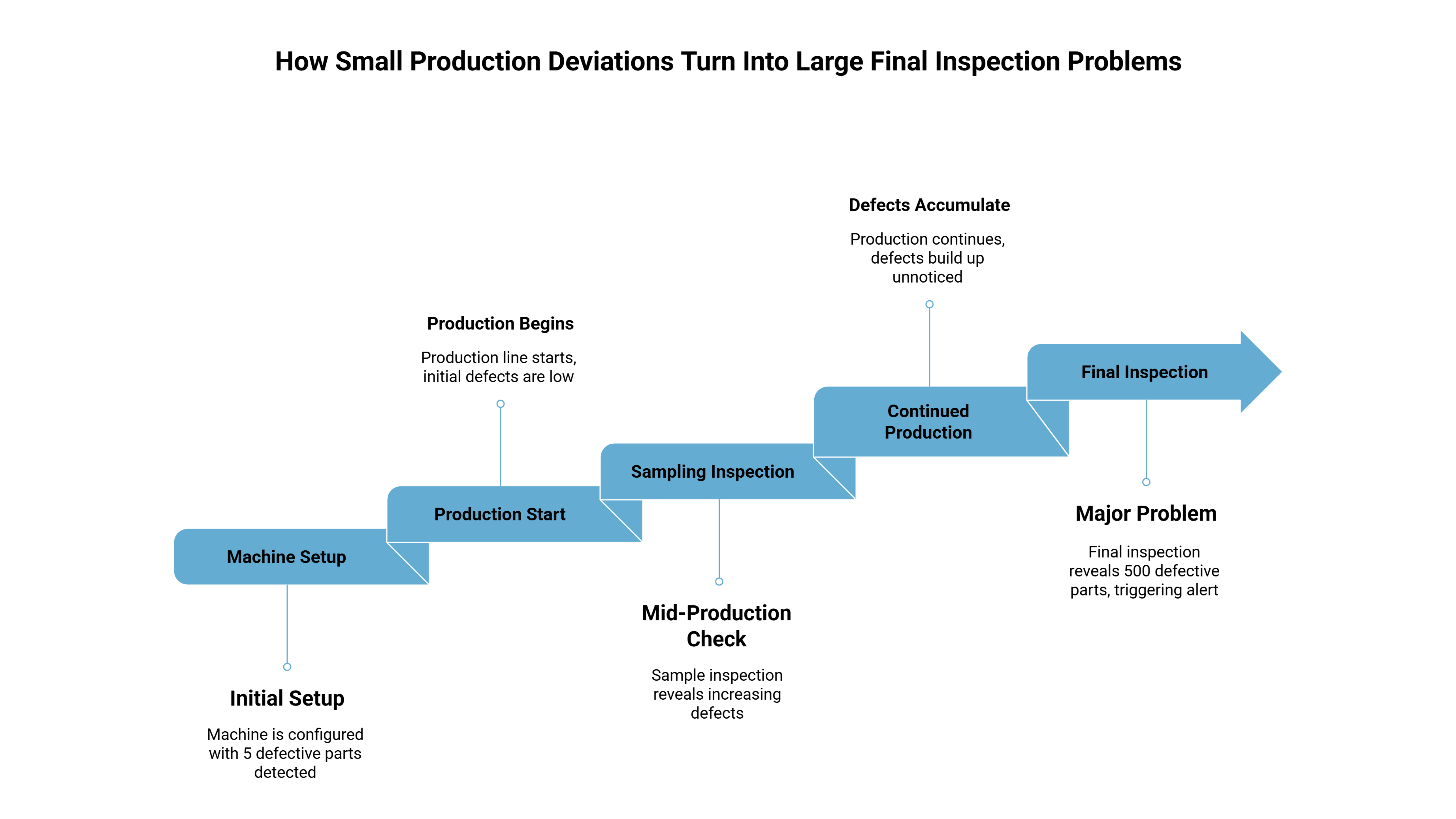
For example, imagine a fixture shifting slightly during production. The first few units pass inspection without issue. Over the next several hours, alignment gradually moves further out of tolerance. Operators continue production because sampled parts still appear acceptable.
By the time the issue becomes visible at final inspection, hundreds of units may already be affected. What could have been corrected after 5 defective parts becomes a rework problem involving 500.
This is one of the biggest final inspection challenges in manufacturing environments. Defects are often discovered only after production volume amplifies the impact.
The problem is the delay between defect formation and defect visibility.
Final Inspection Often Carries Too Much Responsibility
Final QC checkpoints are necessary. They help prevent defective products from reaching customers.
But many production environments gradually turn final inspection into the primary layer of defect detection. That creates a reactive quality process.
Final inspection happens after material, labor, machine time, packaging, and production capacity have already been consumed. At that point, inspectors are evaluating completed output rather than controlling process drift while production is still running.
Final inspection can stop defective products from shipping, but it cannot recover the production time already lost creating them.
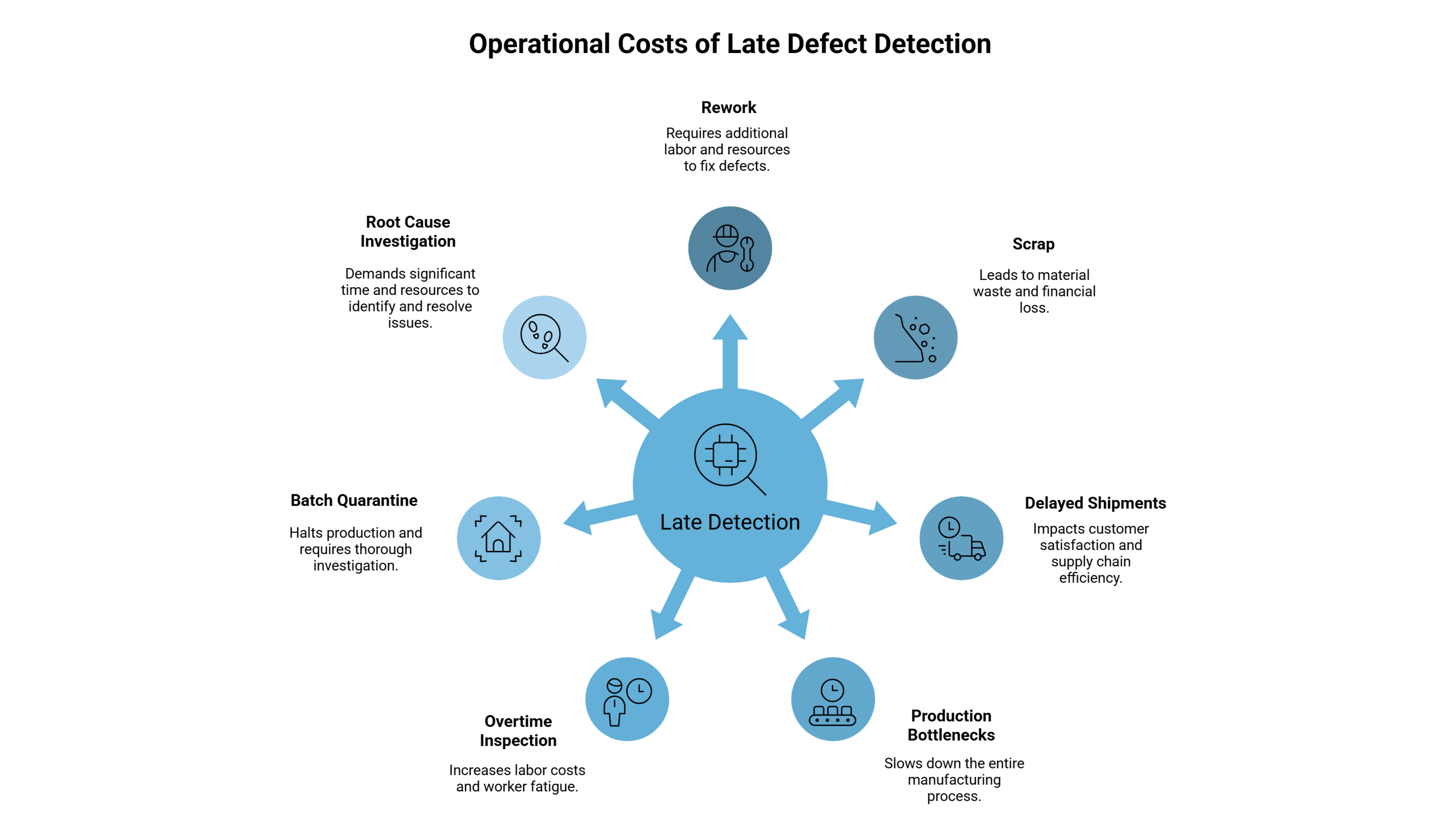
Once defects are discovered late in the process, the operational consequences spread quickly:
- Rework increases
- Scrap accumulates
- Production schedules shift
- Shipments get delayed
- Inspection pressure rises
- Sorting activities consume operator time
- Engineering teams restart root-cause investigations
And when the same defects continue appearing repeatedly, the issue is usually not weak final inspection. It is limited visibility earlier in production.
The Hidden Cost of Late Manufacturing Defect Detection
Late manufacturing defect detection affects far more than quality metrics. It disrupts production flow itself.
A dimensional issue caught immediately after machining may require a small adjustment. The same issue discovered after assembly, coating, packaging, and final inspection becomes a much larger operational problem.
The later a defect is discovered, the larger the correction effort becomes.
A small upstream inconsistency can eventually trigger:
- Batch quarantines
- Overtime rework
- Additional inspections
- Delayed dispatch timelines
- Uncertain finished inventory
- Production bottlenecks
In many factories, quality teams spend significant time reacting to defects that have already spread through multiple stages of manufacturing.
And once recurring issues reach this point, inspection alone rarely solves the underlying problem.
Operational Blind Spots Before Defects Become Visible
Many defects only become noticeable after downstream processing stages.
A surface inconsistency may only become visible after painting or coating. A dimensional deviation may affect fitment only during final assembly. Minor defects that appear acceptable individually may combine with other inconsistencies later and exceed tolerance limits.
As a result, production can appear stable while defects continue building underneath daily output.
This is why many factories repeatedly face the same quality issues even after corrective actions are implemented. The visible defect gets corrected, but the upstream conditions allowing the defect to develop often remain unchanged.
Improving Visibility Before Defects Escalate
Reducing quality issues is not simply about increasing inspections at the end of production. It is about improving visibility before small process problems grow into larger failures.
That usually means paying closer attention to:
- Process consistency during production
- Early-stage defect signals
- Recurring drift across shifts or batches
- Inspection gaps between checkpoints
- Repeat defect patterns
- Inconsistencies in visual inspection standards
The goal is not to eliminate final inspection. Final QC will always remain necessary in manufacturing environments.
But relying only on final inspection creates a system where problems are discovered only after operational damage has already spread through production.
Factories that improve visibility earlier in production can often reduce both defect rates and operational disruption.
Because in manufacturing, the cost of a defect is rarely limited to the defect itself.
By the time it reaches final inspection, production has already absorbed the time, material, and effort behind the mistake.

Most Quality Issues Don’t Start at Final Inspection